23.4.2026 | News
As a result of the war in Iran, there was a significant decline in optimism among medium-sized firms in the first quarter of 2026, falling by six percentage points to 68%. This is according to an analysis by the International Business Report from the consultancy firm Grant Thornton International.
Senior company executives are expressing concerns about the war’s impact on delivery times and the costs of transporting or delivering goods. The proportion of those expecting an increase in their supply chain rose by five percentage points to 47%. Concerns about a lack of orders due to weakened demand dynamics also rose by four percentage points, to 48%.
The report also highlights a five-percentage-point rise in concerns about geopolitical turmoil, with 51% of senior managers perceiving this as an obstacle to their business. This situation has also led to increased concerns about economic uncertainty, which is a worry for 57% of respondents, representing a rise of four percentage points.
By comparison, in Slovakia, the Economic Sentiment Indicator (ESI) fell by 2.5 points in March to 95, the lowest level in the last five months. According to the Statistical Office of the Slovak Republic, economic sentiment has deteriorated by 4.6 points year-on-year and lags behind the long-term average by more than 10 points. A value below 100 indicates negative sentiment.
The paradoxical and, at the same time, sad reality is that medium-sized firms now have sufficient recent experience to draw upon, even if the war continues to have clearly negative consequences for their business, particularly if the Strait of Hormuz remains closed or restricted for the long term. Companies are better able to absorb major market shocks thanks to the measures they had to adopt as a result of the Russian invasion of Ukraine and anti-pandemic measures.
It is precisely these recent experiences of managing shocks in energy markets and supply chains that may explain why profitability expectations remain unchanged, with 64% of firms still anticipating growth.
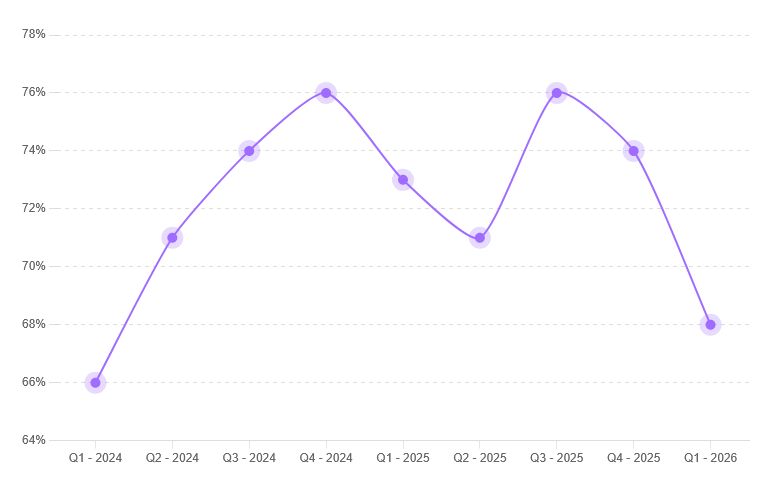
Trends in global business optimism 2024–2026. Source: Grant Thornton International
It appears that most firms are hoping for a short-term conflict that they will be able to manage, whilst the proportion of those expecting to raise selling prices in response to inflationary pressures has risen by just two percentage points, to 51%.
“The decline in optimism in the first quarter of this year reflects the very real impact of geopolitical events, such as the war in Iran, on businesses worldwide. At the same time, however, other indicators show the extent to which medium-sized firms have become accustomed to operating in conditions of uncertainty. They built up this resilience during the Covid pandemic and the war in Ukraine. The key factor now will be, above all, how long this period of instability lasts. Medium-sized firms are able to adapt quickly, but long-term uncertainty inevitably weighs on them more and more heavily,” said Greg Keith, CEO of Grant Thornton International.
“Despite the decline in optimism, companies continue to invest in technology, people and innovation. This is an important signal. The fundamentals remain sound, and although leaders must respond pragmatically to shocks of this kind, it is clear that they are focusing on long-term management,” added Greg Keith.
At the same time, experience in managing geopolitical crises, energy shocks and disrupted supply chains is changing mid-market companies’ view of sustainability as a strategic element of long-term resilience. How these approaches differ across regions and what business opportunities they create is explored in the analysis “Scaling sustainability: How the mid-market is future-proofing growth”.
You can find more information from the International Business Report here
Filip Tichý | 25.9.2026 | News
Experience with Building AI Agents: Tech Companies vs.…The authors of this article, Filip Tichý (Partner at Grant Thornton Slovakia)…
Ľubomíra Murgašová | 23.9.2026 | News
E-invoicing from 1 January 2027: what businesses need to…Mandatory e-invoicing in Slovakia is approaching – from 1 January 2027,…
Silvia Hallová | 10.9.2026 | News
The ‘Švarc’ scheme in the IT sector: a new ruling from the…The Financial Administration has been focusing on uncovering fictitious self…



